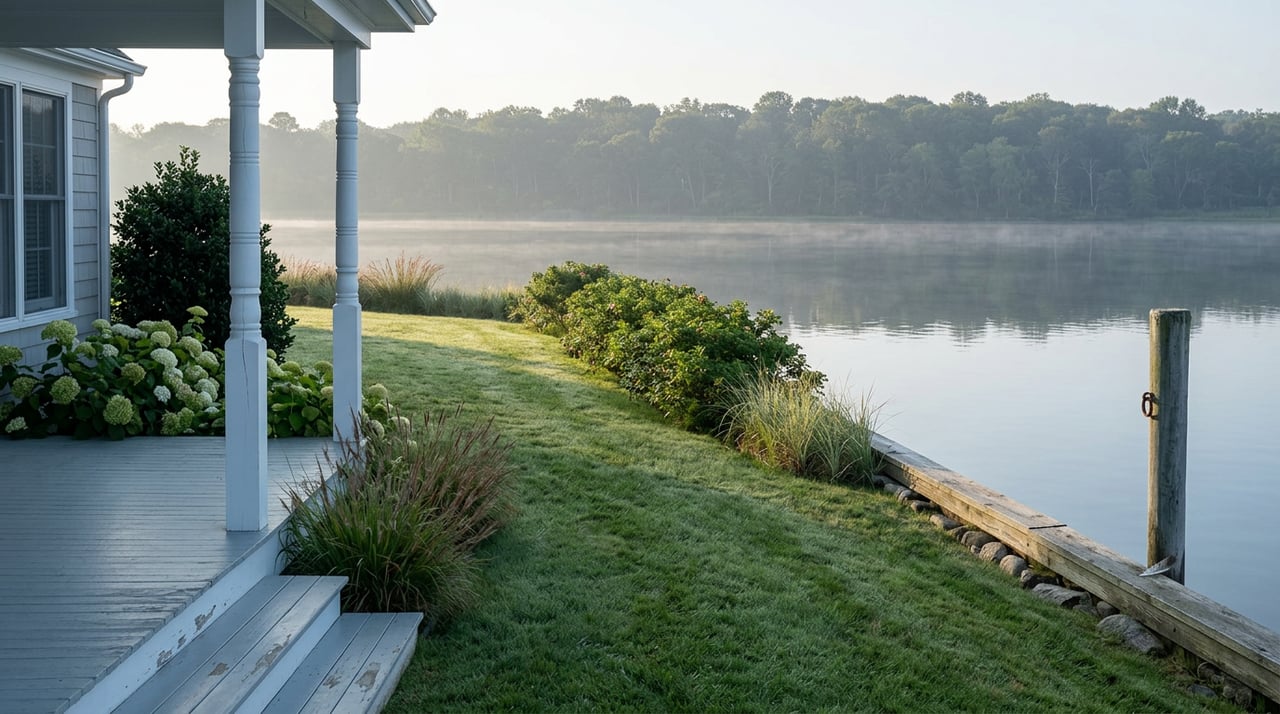
At a Village of Greenport work session on November 20, 2025, Trustee Mary Bess Phillips asked Mayor Kevin Stuessi again when work would start on the Mitchell Park bulkhead. The village had secured a $3 million federal grant back in 2024 to replace the marina's 776-foot timber bulkhead with new vinyl, plus roughly $1.5 million in bonding funds for emergency repairs behind the East End Seaport Museum after a Nor'easter collapsed part of the wall. As of November 24, 2025, nineteen months after the grant was announced, the village had not filed a DEC permit application. As North Fork Sun reported, Phillips said: "It's just a little bit frustrating that it's taken this long to get it moving."
That sentence is worth sitting with if you own, or plan to buy, waterfront property in Greenport. At the November 2025 work session, work had not yet begun, nearly two years after the grant was announced. For private owners, multiple approvals can stand between "the bulkhead needs work" and "the bulkhead is fixed," and can affect a waterfront closing.
Three Agencies, One Wall
A bulkhead repair or replacement in Greenport doesn't answer to one authority. It answers to three, and each has its own process.
At the local level, the Village of Greenport requires a wetlands permit issued by the Board of Trustees for any bulkheading, dredging, or dock work, with fees tied to the cost of the job. The village's own permit form, WLP1, asks applicants to check off which additional approvals the project will also need: a building permit, site plan approval, possibly a zoning board variance, and sign-off from the Suffolk County Health Department, the New York State DEC, and the Army Corps of Engineers, depending on scope.
At the state level, the DEC has a General Permit specifically for tidal wetland bulkhead replacement, but it only covers Nassau and Suffolk counties outside of high wave energy areas and vegetated tidal wetlands. A straightforward in-kind, in-place swap, removing an old bulkhead and rebuilding it in the same footprint, generally qualifies for a faster Standard Activity Permit track. Anything that expands seaward, sits in a more sensitive wetland zone, or changes elevation beyond a modest threshold can get bumped into a slower individual permit review, sometimes with a state coastal zone consistency check layered on top.
At the federal level, the Army Corps typically allows in-kind repairs under a Nationwide Permit, which moves faster than an individual permit, but only if the project stays within those same in-kind, in-place boundaries.
Three agencies, three timelines, and a project only moves as fast as the slowest one signs off. The Mitchell Park project illustrates how separate review processes can shape a waterfront project's timeline.
The Mitchell Park Project Timeline
The Mitchell Park bulkhead wasn't a mystery. A 2018 engineering report had already flagged wood decay, bowing, sinkholes, and marine borer damage, and recommended full replacement over patchwork repair. A 2024 Nor'easter made the warning literal when part of the structure behind the East End Seaport Museum collapsed, exposing an electrical panel that trustees worried could fall into the harbor.
The village moved to secure funding. Representative Nick LaLota announced the $3 million federal grant in 2024. The board added roughly $1.5 million in bonding for emergency work. According to reporting from North Fork Sun as of November 24, 2025, no DEC permit application had been submitted at that point; the mayor had told trustees for months that the paperwork was "in process." By the November 20 work session, the board was discussing a resolution to formally declare the permits emergencies. Mayor Stuessi told trustees the electrical box relocation would begin in December 2025, with the larger bulkhead work to follow in early 2026, nearly two years after the grant was announced.
Mitchell Park Marina generates more than 20 percent of the village's general fund revenue, according to village records cited by North Fork Sun. The marina's contribution gives the bulkhead project financial significance for the village, while permit review remained part of the project timeline.
Private Bulkhead Projects Also Face Multiple Approvals
Private bulkhead work in Greenport also involves a layered approval process, with potential implications for project timing.
Back in 2015, a shipyard replacing several hundred feet of bulkhead at 210 Carpenter Street discovered mid-project that its DEC permit had expired without anyone noticing, according to SoutholdLOCAL's coverage at the time. The owner, a longtime waterfront operator who had also served as village mayor, put it plainly: he hadn't realized after decades on the water that a village wetlands permit was required at all. The project drew a stop-work order, a Citizen Advisory Council review, and a public hearing before it could resume.
A separate 2023 dispute at the same shipyard centered on whether replacing a wood bulkhead with impermeable plastic should trigger soil testing, given the site's history as a wartime shipbuilding yard. According to the Suffolk Times, an environmental consultant with three decades in permitting said no such requirement existed under state or federal law, but the village's advisory committee pushed for it anyway as a matter of local judgment, and the question worked its way through a full wetlands permit hearing before a board vote.
These cases involved commercial operators rather than homeowners with a modest residential dock. They illustrate that even experienced waterfront operators may need to navigate multiple approvals for bulkhead work.
What a Private Bulkhead Actually Costs
For a typical residential shoreline, the money is more predictable than the timeline. Long Island contractors report concrete bulkhead pricing between roughly $200 and $600 per linear foot, with Nassau and Suffolk County homeowners often landing toward the higher end because of saltwater exposure and site access challenges. Bulkhead material and installation for a common 100-foot residential replacement can run roughly $20,000 to $60,000 or more.
| Cost component | Typical range |
|---|---|
| Bulkhead material and installation | $200 to $600+ per linear foot |
| Engineering and design | $1,500 to $3,500 |
| Demolition and disposal of old structure | $75 to $250 per linear foot |
| Drainage systems and weep holes | $15 to $55 per linear foot |
Those line items do not include potential permitting-related delays. Depending on the project, such delays can affect listing preparation, closing timing, or the length of a buyer's financing contingency.
What This Means at the Closing Table
For sellers, the Mitchell Park timeline is a reason to get ahead of a known bulkhead issue rather than waiting for an inspection to surface it. A current site survey, an engineer's assessment, or even a submitted permit application in hand at listing time turns a liability into a documented plan, which reads very differently to a buyer than a vague promise to "deal with it." As of April 2026, Greenport had 14 waterfront homes on the market at a median asking price of $1.4 million, with most spending around 62 days on the market. On inventory at that price point, a documented, permit-forward bulkhead plan is a genuine point of difference, not a footnote.
For buyers, the lesson cuts the other way. If an inspection turns up a deteriorating bulkhead, the right question isn't just "what will this cost to fix." It's "who owns the permitting timeline between contract and closing, and what happens if it runs long." A seller credit based on a contractor's six-week repair quote may not account for a DEC or Army Corps review that can run six months to a year. Structuring the contract around that possibility, whether through an extended contingency period, an escrow holdback tied to permit milestones, or a price adjustment that reflects the carrying cost of delay, can better account for potential delay than relying on the repair quote alone.
Quick Answers
Does storm damage to a bulkhead get an emergency permit? Sometimes, but even emergency provisions still route through the DEC and often the Army Corps. At the November 2025 work session, the board discussed declaring the permits emergencies by resolution; that would not eliminate the permitting process.
Is an in-kind, in-place replacement always faster? It's the more favorable permit category under the DEC's general permit for Nassau and Suffolk counties. Faster is relative, not guaranteed.
What should a purchase contract say if bulkhead condition is unclear? At minimum, a contingency period long enough to get a marine contractor's assessment, and clear language on who is responsible for initiating any required permits before closing.
A bulkhead is one of the few features on a Greenport waterfront property where the paperwork can matter more than the price. If you're evaluating a property with shoreline structure in question, or preparing to list one, The Principi Team can help you read the permitting picture clearly before you write or accept an offer. Contact us.
This article is general information, not legal, tax or financial advice. Consult a qualified professional about your situation.
