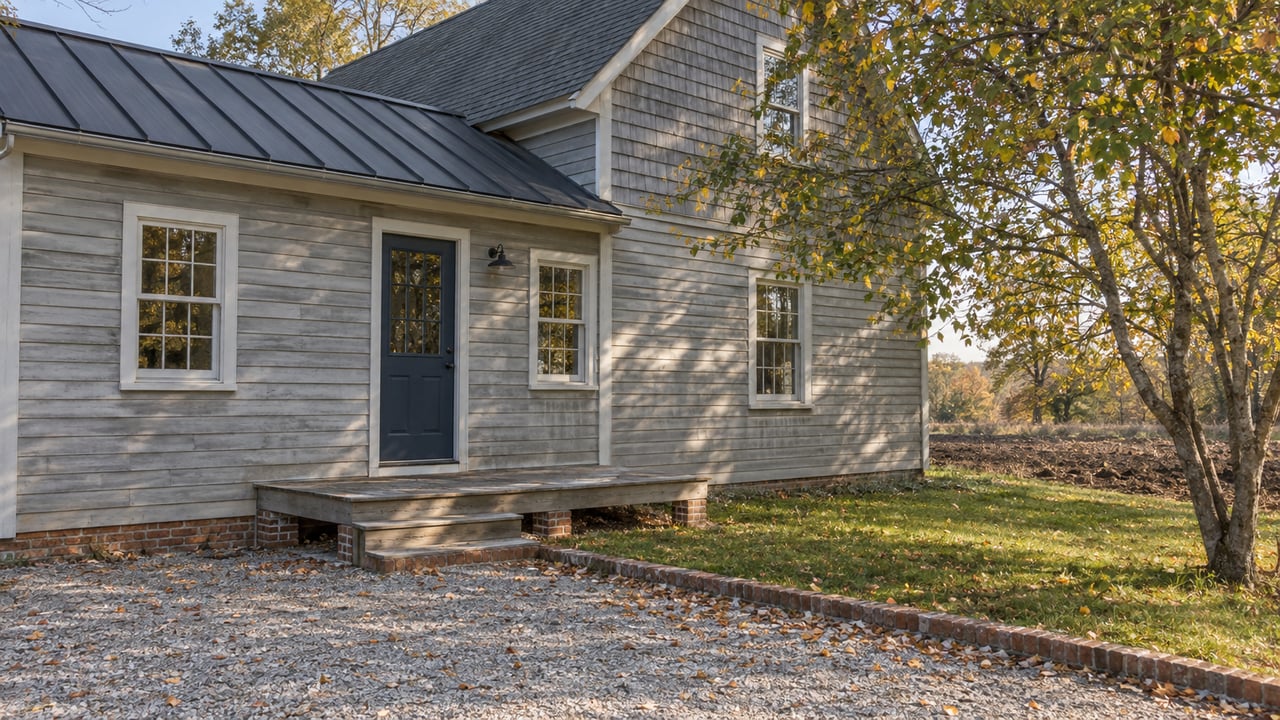
The Southold Town Meeting Hall was full by the time the hearing on 4180 New Suffolk Avenue got underway on Monday, September 14. More than 20 residents spoke over roughly 90 minutes, most of them neighbors of a 14-acre farm on the edge of Deep Hole Creek. The property is preserved. The town holds development rights over 12 of its acres. And yet the argument that night wasn't about whether something could be built there. It was about how big that something might become.
That distinction is the part buyers of preserved North Fork farmland tend to miss. A sold development right sounds like a ceiling. In practice, it's closer to a floor with a small room still standing on top of it, and figuring out what fits in that room, and who gets a say in the fit, is where the real transaction risk lives.
The Deal That Already Happened
The land at 4180 New Suffolk Avenue was headed toward seven residential lots before the Peconic Land Trust bought it in 2022, with help from close to $670,000 in community donations. The trust then sold the parcel to Will Peckham of West Robins Oyster Company in 2023 for $1.6 million, with 12 of its roughly 14 acres locked under an agricultural easement held by the Town of Southold. That's the preservation story, and it's the one most buyers stop reading at. The land can't be subdivided. The land can't hold a subdivision's worth of houses. Case closed.
Except the easement didn't touch the whole parcel. About 2.2 acres on the eastern side of the property sit outside the development-rights sale entirely, reserved specifically so working structures can still go up. That reserve area is where Peckham has proposed a 1,300-square-foot farmhouse, a 3,000-square-foot pole barn, a 1,500-square-foot agricultural production building, and a 288-square-foot farm stand. None of it required buying back development rights. It was baked into the deal from the start.
For anyone evaluating preserved farmland as an investment, whether for a vineyard, a farm operation, or an agritourism use, this is the number that actually matters: not the total acreage under easement, but the size and location of whatever reserve area survived the sale. That's the buildable envelope. It's usually a fraction of the parcel, and it's usually spelled out in the same easement documents that advertise how much land got "protected."
The Math Behind the Shucking House
Even inside that reserve area, what a farm can build is only half the equation. What it can sell is governed by a separate piece of code, and it's the one that turned a farmhouse-and-farm-stand proposal into a fight over industrial scale.
Southold Town code requires that at least 66 percent of the product processed on an agricultural property come from that farm's own operation. Peckham currently grows something in the range of 600,000 to 700,000 market oysters a year. Do the math forward and the ceiling becomes concrete: if the operation grew to a million oysters annually, it could legally process up to roughly 300,000 oysters grown by other farmers without tripping the code. Below that ratio, any amount is fair game. Above it, the town has grounds to intervene.
That's a genuinely useful mechanism to understand before buying into a preserved agricultural parcel with processing ambitions. Your own production volume isn't just a revenue line. It's the throttle on how much outside business you're legally allowed to bring onto the property. A buyer who wants a large processing operation on a small farm can't get there by permit alone. The farm has to grow first.
Why the Room Was Full
None of that math explains why 20 people stood up on a Monday night. That part came down to uncertainty, and it's the part no easement or code section resolves in advance.
Several neighbors, having helped raise money to preserve the land in the first place, said the project felt like it was outgrowing the deal they'd bought into. Comparisons circulated to a Southold chicken farm proposal that had recently been scrapped after similar pushback. When Peckham was asked what the business might look like five years out, he said he honestly didn't know. One resident, Bill Boyden, said that answer was the one that concerned him most, not because it was dishonest, but because it left the ceiling undefined in a way the code technically permits.
Peckham's own framing, offered at the hearing, was simple: aquaculture is agriculture. Legally, he's right. The zoning, the easement, and the processing rule all treat a shellfish operation the same way they'd treat a vegetable farm. But a room full of neighbors doesn't vote on legal categories. It votes on gut sense of scale, and that vote, expressed through public comment rather than a ballot, can slow a project for months even when every proposed structure fits inside the buildable envelope by right.
The written comment period on this application runs 30 days past the September 14 hearing, meaning the town won't have a full record until mid-October. Any buyer evaluating a similarly preserved parcel should build that kind of runway into a timeline from the start. The reserve acreage and the processing formula are knowable before an offer goes in. The length and temperature of the public hearing that follows generally is not.
The Tailwind Underneath the Friction
It's worth noting that the regulatory current is moving toward, not against, working waterfront uses like this one, even as individual hearings stay contentious. Suffolk County passed a "working waterfront" bill, signed in Greenport in September 2025, that created conservation easements specifically protecting shellfish farming, commercial fishing, marine repair, and recreational boating operations from development pressure. In January 2026, Southold moved to fold its long-inactive shellfish advisory committee into its agricultural advisory committee, formally recognizing aquaculture as part of the same policy conversation as land farming, with the added authority to weigh in on Planning Board and Town Board decisions that touch it.
None of that guarantees a specific outcome for a specific hearing. But it does mean that a buyer looking at aquaculture or agritourism potential on preserved North Fork land is operating in a policy environment that's actively building infrastructure to support those uses, not one still figuring out whether they belong.
What This Means Before You Write an Offer
A parcel advertised as "preserved" or "under agricultural easement" isn't a museum piece. It's a property where most, but rarely all, of the acreage has had its development rights sold off, usually leaving a defined reserve area where structures can still legally rise. Before assuming a preserved parcel is frozen, or assuming it's wide open, it's worth asking three concrete questions: how many acres sit outside the easement, what specific structures does the easement language permit there, and what production or processing thresholds, if any, cap how the business built on those structures can grow.
Those answers sit in the deed and the easement documents, not in the listing description. Reading them before an offer, rather than after a hearing, is the difference between knowing your ceiling and discovering it in a packed town hall.
If you're evaluating a preserved or easement-restricted parcel on the North Fork and want a clear read on what its remaining acreage actually allows, The Principi Team can walk through the deed language, the reserve area, and the approval path before you make an offer.
